


Posted by L’équipe Ameublement à rabais
on October 31, 2026

Last updated: November 1, 2026
Quick Summary
To choose a dog gate, first measure the actual width of the opening, the available height, and the depth of the frame, then match the mounting method to the support. A pressure-fit gate is suitable for flat, rigid surfaces, while a screw-in mount is more stable at the top of stairs or on a drywall wall.
- Measure the opening at three heights, as an older frame is rarely plumb.
- The spacing between the bars of the models in the selection ranges from 5 to 5.7 cm.
- At the top of stairs, prefer a screw-in or wall-mounted installation over a pressure-fit gate.
- The 75 to 131 cm range corresponds to the extra-wide white gate with a small door.
- A dog that jumps or pushes requires a steel frame and double locking.
Table of Contents
- Dog gate: the criteria that really matter
- Comparison of available dog gates
- Dog gate without drilling: mounting and stability
- Dog gate for stairs: safety at height
- Dog gate for door and hallway: width and passage
- Dog enclosure: when the gate is no longer enough
- Choosing the gate suited to your dog and your space
- Frequently Asked Questions
Dog gate: the criteria that really matter
A dog gate is a safety device that defines a space without building a permanent wall. It is installed in an opening, placed at the bottom of stairs, or deployed as an enclosure, depending on the need. The most frequent questions concern less the style than three concrete points: the actual width of the opening, the height of the dog, and the possible mounting method in the home.
The starting point is almost always the same. A owner measures their door frame incorrectly, orders a gate that is too short, then discovers that the adjustable screws are not enough. A dog gate is therefore chosen with a measuring tape in hand, not with a product photo.
Measure the opening before shopping
Three measurements decide everything. The interior width of the opening, taken at the narrowest point. The available height, especially under a railing or handrail. And the depth of the frame, because a drywall wall and a wooden frame do not offer the same grip to a pressure mounting.
A useful reflex: measure in three places, at the top, in the middle, and at the bottom. An old door frame is rarely plumb. If the difference exceeds a few millimeters, plan for a gate whose adjustment range covers the largest measured width, never the smallest.
Comparison of available dog gates
The following table summarizes some of the models offered, with their dimensions and their most logical use.
| Model | Adjustable width | Height | Price | Best for |
|---|---|---|---|---|
| Metal gate with automatic closing door | 75 to 82 cm | 76 cm | $69.99 | Small openings, puppy |
| Extra-wide gate with small door, black | 75 to 82 cm | 76 cm | $83.99 | Door or narrow hallway |
| Extra-wide pet gate with small door | 76 to 104 cm | 77 cm | $78.99 | Medium opening, small pet |
| Gate with automatic closing, black | 76 to 129 cm | 76 cm | $82.99 | Wide hallway, puppy |
| Extra-wide gate with small door, white | 75 to 131 cm | 76 cm | $93.99 | Large opening, dual use |
The widest model in the selection, the extra-wide pet gate with small door, illustrates the compromise to be made. Its range of 76 to 104 cm and its 20 cm by 19.5 cm pet door allow a small animal to pass through without opening the main panel. It is advertised for dogs measuring 25 to 50 cm around the neck, which makes it suitable for small and medium breeds.

Dog gate without drilling: mounting and stability
A dog gate without drilling holds by pressure: two threaded legs rest on the uprights and create tension that immobilizes the panel. It leaves no marks and is easily removed.
Stability depends on three elements, not just one. For a proven pressure mounting solution, the black safety gate with automatic closing corresponds exactly to this type of installation. The support surface must be flat and rigid. The legs must be tightened until the panel no longer moves laterally.

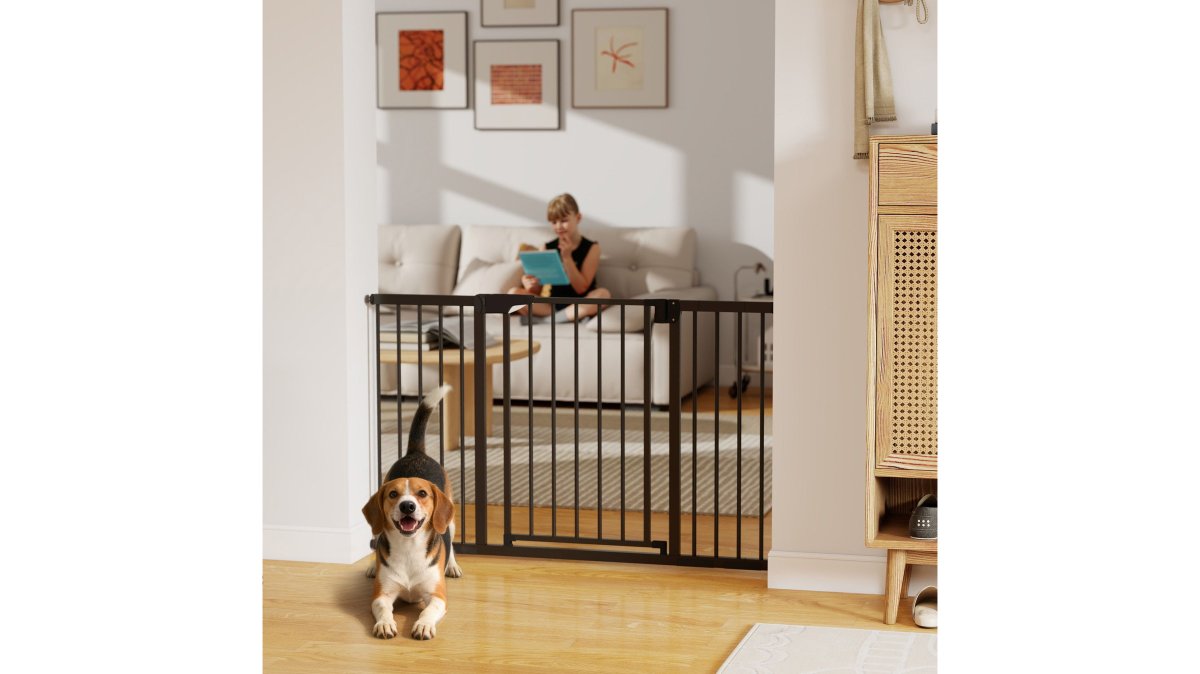
Warning: a pressure mounting placed on a thin plastic baseboard or an improperly anchored door frame can slide under the push of a jumping dog. In this case, a screw-in installation is more stable.
Dog gate for stairs: safety at height
At the top of stairs, the dog gate for stairs not only protects against going down: it also prevents access to an area where a fall is possible. The deciding criterion becomes the closing. A door that closes by itself within a limited angle prevents a panel from remaining open after the passage of a busy adult.
Double locking counts just as much. A dog that pushes with its muzzle on a simply latched door can open it.
The metal gate with automatic closing door and double locking offers automatic closing under 90 degrees and two-way opening. Its range of 75 to 82 cm can be suitable for narrow passages.
The safety points that product sheets forget
A poorly chosen gate at the top of stairs creates a risk itself. Here are the checks that matter, and that few product descriptions address.
The spacing between the bars. On the models in this selection, it ranges from 5 to 5.7 cm.
The mounting at the top of stairs. A pressure-fit gate placed at the top of stairs must rest on flat and rigid surfaces.
The opening direction. A door that opens toward the stairs creates an obstacle in the passage area.
The height under the handrail. A railing or handrail limits the available height.
Supervision remains necessary. No gate replaces the supervision of a puppy or a dog that is not used to stairs.
Extra-wide pet gate with small door →
Warning
At the top of stairs, prefer a screw-in or wall-mounted installation over a pressure-fit gate. Check the spacing of the bars and the height under the handrail before purchase, and retighten the mountings once a season.
Choosing according to the stair configuration
A narrow staircase accommodates a gate of 75 to 82 cm. A wider staircase requires a broader adjustment range. If the stairs lead to a basement or a small landing, a gate with a small passage door avoids having to step over it every time you go back and forth. For a dog that jumps or pushes, a steel frame and double locking are the minimum; a taller model may be necessary depending on the size of the animal.
Dog gate for door and hallway: width and passage
A wide hallway is the case most poorly served by standard gates. Between 110 and 131 cm, most common models no longer reach the frame. The range of 75 to 131 cm corresponds to the extra-wide safety gate with small door, white, which offers a passage opening of 60 cm.

This passage width changes daily use.
Dog enclosure: when the gate is no longer enough
A dog enclosure becomes relevant when the constraint is no longer an opening but a surface. A gate blocks a passage. An enclosure defines an area: a corner of the basement, a section of the patio, a space near an exterior door.
The practical difference lies in the configuration. It is also suitable for puppies during the house-training period, when you need to limit the available space rather than close off a room.
An honest caveat: an enclosure placed on a hard surface will move if the dog gets momentum. On a deck or patio, plan for an anchor or a non-slip mat under the panels.
Choosing the gate suited to your dog and your space
The dog's temperament counts as much as the measurements. A dog that jumps or presses its full weight on the bars puts more strain on the frame and the locking.
The ability to jump determines the useful height. A 76 cm model is suitable for a small dog.
A simple method to adapt the gate to the dog
Rather than a checklist, here is a three-step process that links the animal's behavior to the characteristics of the gate. This is the angle that product sheets do not address.
1. Assess the ability to jump. Observe the dog in an open space: does it jump on furniture, does it clear a low obstacle?
2. Assess the push and weight. A dog that presses its full weight on the bars, or pushes with its muzzle, puts strain on the mounting. A steel frame and double locking are then priorities.
3. Check the size at the shoulder. The height of the gate should exceed the dog's height at the shoulder by a reasonable margin.
Decision table by profile
| Dog profile | Target height | Strength and mounting | Passage |
|---|---|---|---|
| Calm puppy, small breed | 76 cm | Light frame, pressure | Small useful door |
| Calm dog, medium size | 76 cm | Steel frame, pressure or screwed | Standard door |
| Jumping dog | More than 76 cm | Steel frame, double locking | Self-closing door |
| Pushing dog | 76 cm or more | Screwed or wall mounting | Double locking |
| Small animal (cat, rabbit) | 76 cm | Reduced bar spacing | Small door |
This table does not replace measurements, but it guides the choice before shopping. To ask a question or make a purchase, the Contact page provides a simple way to reach the store.
The process that avoids the most common mistakes
- Measure the width at the narrowest point, at three heights
- Check the dog's height at the shoulder and its tendency to jump
- Confirm the nature of the support: plaster, wood, metal, baseboard
- Decide between pressure mounting and screwed installation
- Check the passage width needed for daily use
- Plan for secondary use: cat flap, enclosure, patio
One point that product sheets rarely mention: the spacing between the bars. On the models in this selection, it is around 5 to 5.7 cm, which is suitable for a small or medium-sized dog. For a very small breed puppy or a small animal, this gap deserves a check before purchase.
Key Point
Adapting the gate to the dog comes down to three criteria: the ability to jump, pushing, and height at the shoulder. A dog that jumps or pushes requires a steel frame, double locking, and sometimes a height greater than 76 cm. A calm dog tolerates a lighter and easier to handle model.
Frequently Asked Questions
How to choose a dog gate?
First measure the exact width of the opening, then check the gate's adjustment range. Take into account the size of your dog: a gate 76 cm high is suitable for a small or medium dog, while a jumping dog may require a taller model. Also check the mounting method (pressure or screw) and the spacing of the bars.
Which dog gate to choose for stairs?
For stairs, favor a gate that attaches securely, ideally with screws or with a lower stability block. Check the width to cover and favor double locking. A one-handed opening and automatic closing are practical for daily use.
Are there dog gates without drilling?
Yes, several dog gates without drilling work by pressure: adjustable screws compress the gate against the uprights of the opening. This system leaves no trace. For stairs or a dog that pushes hard, a screwed installation can offer superior stability. Check that the wall surface supports the pressure before purchase.
How to measure the opening before buying a dog gate?
Measure the width between the two support surfaces (door uprights or walls) at three different heights, because walls are not always perfectly straight. Take the narrowest measurement. Then check that this width falls within the adjustment range indicated by the manufacturer. Also measure the available height and the thickness of the baseboards, which can hinder pressure installation. An adjustable gate from 75 to 131 cm covers most common openings.
What is the difference between a dog gate and a dog enclosure?
A dog gate blocks a specific passage, like a door, hallway, or stairs. A dog enclosure delimits a closed area on several sides, inside or outside. The gate is more versatile for moving around the house, while the enclosure offers a more complete delimitation for the patio or yard.

