

Posted by L’équipe Ameublement à rabais
on September 28, 2026

Table of Contents
- Assessing your available space
- Defining your needs and usage
- Choosing the right dimensions for a compact desk
- Fold-away desks and space-saving solutions
- Small office setup with built-in storage
- Ergonomics and work posture
- Materials, style, and integration into your decor
- Straight or corner desks for small spaces
- Frequently Asked Questions
Last update: September 28, 2026
How to choose a compact desk
Choosing the right compact desk turns a cramped corner into a productive workspace. According to Bluedigo, a workspace planning guide, the flex office model recommends a ratio of 0.7 to 0.85 workstations per employee, meaning compact desks are essential for maximizing small spaces. Ameublement à rabais helps home workers, students, and families find solutions adapted to their real-world space constraints.

This article shows you how to evaluate your space, define your specific needs, and select a compact desk that really works. You will learn about ideal dimensions, built-in storage options, and the ergonomic criteria that make a difference.
Assessing your available space
Before looking for a desk, measure your space accurately. Most people miscalculate the dimensions and end up with furniture that doesn't fit or is too bulky.
Start by identifying the corner or room where you will place the desk. Measure the available width, depth, and height. Note the obstacles: windows, doors, radiators, electrical outlets. Leave at least 60 centimeters in front of the desk so you can sit down and stand up comfortably.
Also consider traffic flow. A desk should not block the main path through a room. If you live in a small apartment, the workspace must coexist with other uses: relaxing, eating, sleeping. This changes your choices for dimensions and mobility.
Finally, check the ceiling height if you are considering a desk with shelves above it. Furniture that is too tall visually crowds a small room and creates a feeling of discomfort.
Pro Tip
Photograph your empty space with a visible tape measure. This helps you visualize proportions when browsing products online.
Defining your needs and usage
Usage determines the dimensions and features you truly need. A desk for regular telecommuting has different requirements than an occasional workstation for studying.
Regular telecommuting: If you work from home several days a week, you need a comfortable surface. Plan enough room for a computer, keyboard, mouse, and a few documents. You will also need storage for supplies and folders.
Study or occasional work: For school or intermittent tasks, a more compact desk is sufficient. You can prioritize mobility or the ability to fold it away when not in use.
Multi-use: Some small spaces must serve multiple activities. A fold-away or folding desk then becomes a smart solution. It frees up space the rest of the time.
Also think about your equipment. A laptop requires less surface area than a larger desktop monitor. Working on paper requires sufficient depth. According to Lenovo, a furniture selection guide, the ideal depth for a stationary computer is 70 to 80 centimeters.
Key Point
Usage defines size. Don't oversize your desk just because you can; furniture adapted to your actual need works better and takes up less space.
Choosing the right dimensions for a compact desk
Standard dimensions for a compact desk vary by depth and width. These figures help you compare real-world options.
Width: The Robin des bois guide, workstation recommendations, suggests a width of 80 to 100 centimeters for a compact desk. This is sufficient for a laptop and the essentials. Below 80 centimeters, space becomes very tight for two screens or for writing.
Depth: The recommended depth is 50 to 70 centimeters. A depth of 50 centimeters suits lightweight laptops. For a stationary computer or more equipment, 60 to 70 centimeters offers more comfort. Marie Claire Maison, a furniture selection guide, confirms that 70 to 80 centimeters is ideal for computer stations.
Height: The standard height for a desk is 72 to 76 centimeters. This is the norm so that your forearms rest at 90 degrees when you are seated. If you are very tall or very short, check that the model adapts to your body type.
| Dimension | Very compact desk | Standard compact desk | Spacious compact desk |
|---|---|---|---|
| Width | 70-80 cm | 80-100 cm | 100-120 cm |
| Depth | 40-50 cm | 50-70 cm | 70-80 cm |
| Height | 72-76 cm | 72-76 cm | 72-76 cm (adjustable option) |
| Ideal for | Laptop only | Laptop + essentials | PC + monitor + documents |
An 80-centimeter surface is considered ideal for a laptop and work essentials. This leaves room for a cup of coffee and a few documents without cluttering the surface.
Fold-away desks and space-saving solutions
A fold-away or folding desk solves the multi-use space challenge. It offers a full workstation surface and disappears when you don't need it.
Wall-mounted folding desk: This type folds against the wall. When closed, it takes up very little space. Open, it offers enough surface area for working. Ameublement à rabais offers the Multifunctional and space-saving wall-mounted folding desk, black with built-in shelves and a chalkboard. This model combines storage and workspace in one piece of furniture.
Wall-mounted folding and convertible desk →

Folding desk with shelves: The Folding desk with 4-tier shelf for small spaces blends vertical storage and a folding surface. When the surface is folded away, the unit takes up little space. The shelves remain accessible for books and supplies.
Advantages of a fold-away desk:
- Frees up space when you are not working
- Often combines storage and work surface
- Ideal for studios and small apartments
- Creates a visual separation between work and living areas
Disadvantages:
- Less total surface area when open
- Requires proper wall installation
Attention
A wall desk must be fixed securely. If you are renting, verify that your lease allows holes in the walls. Otherwise, a folding desk with legs is a better option.
Small office setup with built-in storage
Built-in storage turns a small desk into an organized space. Instead of finding room for filing cabinets, you use the furniture itself.
Types of built-in storage:
- Drawers under the surface
- Shelves above or on the sides
- Closed or open compartments
- Chalkboard or whiteboard for notes
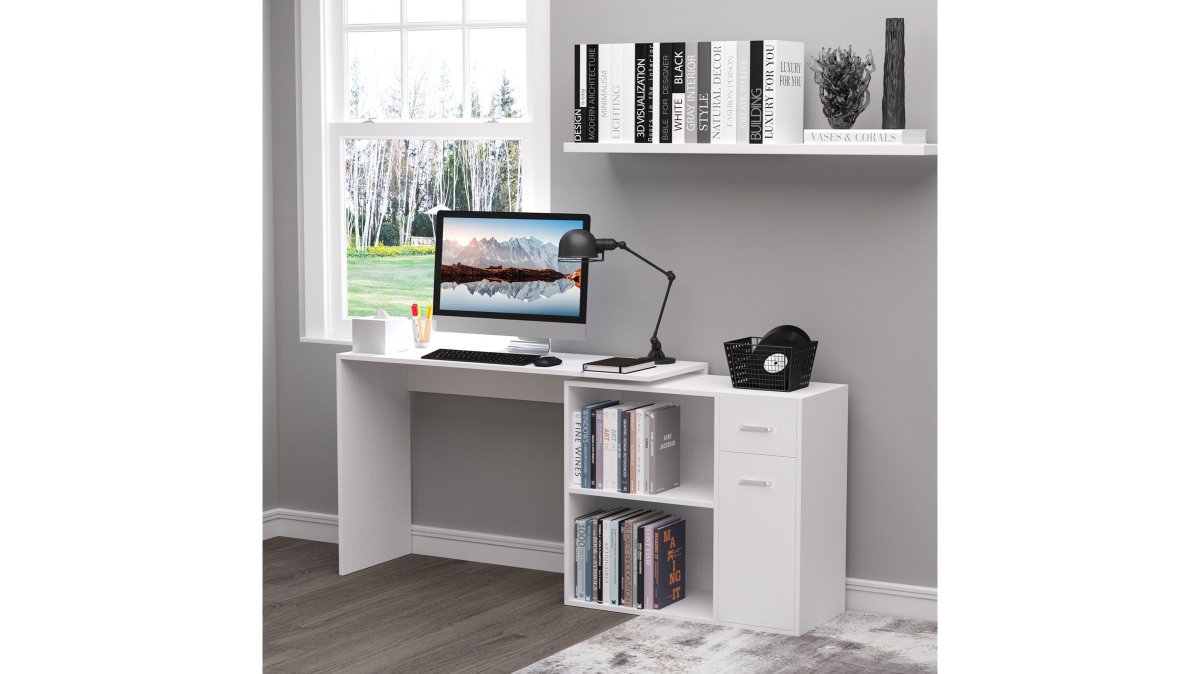
The swivel corner desk from Ameublement à rabais offers an excellent example. The 180° swivel corner desk with storage shelf, white combines a large surface with a drawer, cabinet, and two-tier shelves. This allows you to store supplies, documents, and computer equipment without needing extra furniture.

Tips for optimizing storage:
- Use boxes or baskets to group small items
- Place the most-used items at eye level
- Keep the surface clear to maintain a free workspace
- Use vertical space with additional wall shelves if necessary
Ergonomics and work posture
Ergonomics determines your comfort and long-term health. A poorly configured compact desk causes neck, shoulder, and back pain.
Pro Tip
If you have recurring neck or back pain after working, first adjust the surface and monitor height before buying an expensive chair.
Materials, style, and integration into your decor
The desk material affects its durability, maintenance, and appearance. Small spaces require every piece of furniture to be both functional and aesthetic.
Common materials:
Styles for small spaces:
- Minimalist: clean lines, little decoration, ideal for visually enlarging the space
- Modern: clean design, mixed materials, highly suitable for small offices
- Scandinavian: light wood, functional, warm and welcoming
- Industrial: metal and wood, sturdy, suitable for lofts and studios
Straight desk or corner desk for small spaces
This decision depends on your available space and your usage. Each shape has advantages.
Straight desk:
- Takes up less space in terms of depth
- Easy to place against a wall
- Linear workspace
- Generally less built-in storage
- Good for very narrow spaces
Corner desk:
- Uses two walls, saving floor space
- More total workspace
- Allows for separating work zones
- Often equipped with built-in storage
- Ideal for unused corners
| Criterion | Straight desk | Corner desk |
|---|---|---|
| Floor space | Less | More |
| Workspace | Moderate | Generous |
| Built-in storage | Limited | Often included |
| Flexibility | Low | High |
| Installation | Simple | Requires two walls |
| Ideal for | Very small spaces | Corners and small spaces |
Frequently Asked Questions
What are the ideal dimensions for a compact desk?
For regular use, a compact desk should have a width of 80 to 100 cm and a depth of 70 to 80 cm. A desktop surface of 80 cm is considered ideal for a laptop and work essentials. These dimensions allow you to optimize your workspace while maintaining a functional surface for working comfortably on a daily basis.
How can I set up a home office corner in a small space?
Start by measuring your available space precisely. Opt for a retractable or wall-mounted desk that folds away when not in use, or a pivoting corner desk that adapts to your configuration. Incorporate vertical storage with shelves and drawers to maximize organization without cluttering the floor. Ensure that traffic flow within the room remains clear.
Is a compact desk suitable for regular telecommuting?
Yes, but it depends on your usage. For occasional telecommuting, a solid wood compact desk is sufficient. For regular, daily use, prioritize a more spacious surface with adequate depth (70-80 cm). Verify that your workstation allows for good posture and prolonged comfort.
What materials should I choose for a durable compact desk?
Solid wood and E1-grade particle board are good choices. P2-grade MDF is suitable for functional desks. Check the load capacity (ideally 60 kg or more for the desktop) and opt for a steel or solid wood frame. A melamine finish makes maintenance easier.
