

Posted by L’équipe Ameublement à rabais
on September 23, 2026

Table of Contents
- Why you should carefully compare furniture quality before buying
- Solid wood vs. particle board furniture: understanding the differences
- Interior furniture quality criteria: key points to check
- How to choose a durable sofa: evaluation guide
- Best materials for outdoor furniture: durability and resistance
- Inspection checklist in-store or before delivery
- Weight and density: reliable indicators of quality
- Conclusion
- Frequently Asked Questions
Last updated: September 23, 2026
Why you should carefully compare furniture quality before buying
Buying furniture without checking its quality is like buying a car without looking under the hood. The risk? Ending up with a piece that falls apart after a few months.
According to the Baymard Institute in its 2026 study on furniture e-commerce, the majority of consumers who buy furniture online rely on reviews to assess long-term durability.
Pro Tip
Heavy furniture is generally denser and more durable than light furniture of the same type. Weight is a reliable indicator of quality.
Solid wood vs. particle board furniture: understanding the differences
The difference between solid wood and particle board changes everything. It is the foundation of any furniture purchase decision.
Solid wood: advantages and disadvantages
Solid wood is genuine wood cut directly from a tree (oak, maple, ash, bamboo, etc.).
Advantages of solid wood:
- Can be easily repaired and restored
- Ages well and gains character
- Better resistance to bumps and scratches
- Better for the environment if sourced sustainably
Disadvantages:
- Costs more to purchase
- Can warp with humidity
- Requires regular maintenance (oil, varnish)
- Takes longer to manufacture
Particle board and laminates: when to choose them
Particle boards are made from sawdust compressed with glue. Laminate is a thin layer of plastic or paper glued onto plywood.
Advantages:
- Cheaper than solid wood
- Stable and less sensitive to humidity
- Easy to clean
- Available in more styles and colors
Disadvantages:
- Generally has a 5-10 year lifespan
- Difficult to repair
- Less eco-friendly
Key Point
Solid wood is suitable for furniture you will keep for a long time. Particle board is suitable for temporary pieces or for tight budgets.
Interior furniture quality criteria: key points to check
How do you practically compare furniture quality? Check four things: materials, assembly, finishes, and stability.
Inspecting finishes and assemblies
Finishes reveal quality. Look at how the wood is painted, varnished, or oiled.
Signs of a good finish:
- Smooth surface without dents or scratches
- Uniform color throughout
- No strong chemical odor
- No paint drips
- Tight joints between pieces
Signs of a poor finish:
- Uneven or chipped paint
- Strong smell of solvents
- Mixed glossy and matte areas
- Finish that chips easily to the touch
Stability and solidity test
Stable furniture does not move. Test it in-store or before delivery: push firmly on all four corners, open and close the drawers, check that all legs touch the floor, and listen for squeaks or creaks.
Warning
Unstable furniture can be dangerous, especially if it holds heavy objects or if there are children in the home. Never keep furniture that fails the stability test.
How to choose a durable sofa: evaluation guide
Sofas are a significant investment. Here is how to choose a durable sofa.
Filling materials:
- High-density foam lasts longer
- Individually pocketed springs, better support
Upholstery fabric and cover:
- Genuine leather or 100% cotton, durable and easy to clean
- Microfiber, stain-resistant
Structure:
- Solid wood for the frame, no plywood
- Frame attached with joints, not just staples
- Solid legs (wood or metal)
Best materials for outdoor furniture: durability and resistance
Outdoor furniture undergoes more stress than interior furniture. Materials must withstand water, sun, and temperature changes.
Treated wood:
- Resists rot and insects
- Requires regular sealing
Aluminum:
- Lightweight and does not rust
- Can bend under weight
Natural teak or cedar:
- Very durable
- Requires little maintenance
Synthetic resin:
- Imitates wood without the maintenance
- Can fade in the sun
Key Point
For outdoors, weight indicates quality. Lightweight furniture risks blowing over in the wind. Heavy furniture is generally better constructed.
Inspection checklist in-store or before delivery
Before finalizing your purchase, use this checklist to check for quality.
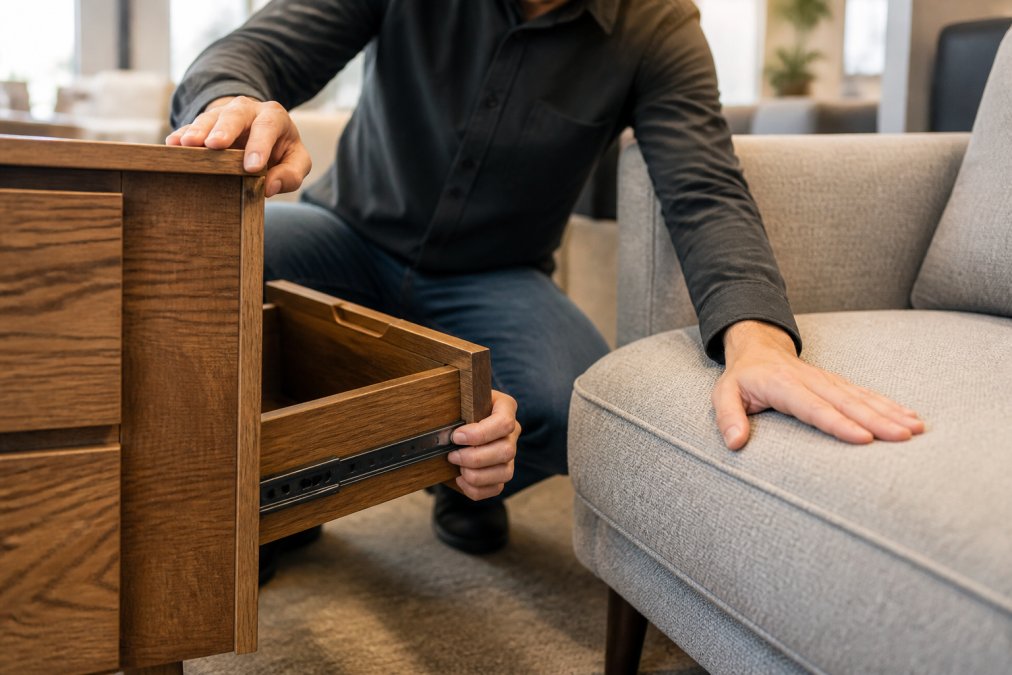
Things to check absolutely:
- The furniture doesn't move when you push it firmly
- All legs touch the floor
- No squeaks or suspicious noises
- Drawers open and close without resistance
- Hinges are solid and well-aligned
- The finish is smooth and uniform
- No strong chemical odor
- Joints are tightly closed
- Wood (if applicable) shows a natural grain
- Fabrics are not torn or stained
- Hardware is in good condition
- Weight matches expectations (not too light)
Weight and density: reliable indicators of quality
Weight is one of the most reliable indicators of furniture quality because superior materials are inherently denser.
Why weight indicates quality
Foam and padding: High-density foam weighs significantly more than low-density foam and retains its shape longer. Low-density foam sags quickly, creating permanent indentations.
How to measure and compare weight
You don't need a scale to assess weight. Here is how to do it:
In-store:
-
Ask the salesperson for the exact weight. This is a standard specification that serious salespeople know.
-
Compare two similar pieces side-by-side. Significantly lighter furniture likely contains less dense materials.
-
Test sofas by sitting on them. A quality sofa does not sag immediately. A sofa that sinks in quickly likely contains low-density foam.
-
Lift the drawers. A heavy drawer with high-quality slides will glide smoothly.
Online:
-
Look for weight specifications. Compare the weight of similar furniture from different brands. A 20 to 30% difference may indicate a quality difference.
-
Read the foam descriptions. Look for mentions of density. If density isn't mentioned, it is likely cheap foam.
-
Check the frame materials. "Solid wood" weighs more than "particle board" or "plywood."
Foam density: reference guide
For sofas, chairs, and mattresses, foam density is critical:
Low density:
- Sags quickly
- Offers little support
- Avoid for long-term use
Medium density (1.2 to 1.8 lb/ft³):
- Acceptable for moderate use
- Good compromise between price and durability
- Common in mid-range furniture
High density (1.8 lb/ft³ and above):
- Retains shape and support longer
- Offers superior comfort and better back support
- Used in high-end furniture
- Justifies a larger investment
Weight by furniture type: what is normal
3-seater solid wood sofa with high-density foam: 45-65 kg (100-145 lb). A significantly lighter sofa likely contains particle board or low-density foam.
Weight as a safety indicator
Weight also plays a role in safety. Lightweight furniture can be unstable or tip over easily. Heavy, well-constructed furniture is generally more stable. This is particularly important for:
- Tall furniture (dressers, bookcases) that could tip over onto children
- Outdoor furniture that must withstand wind
- Chairs and stools that must support weight without tipping
Pro Tip
Always ask for the exact weight of a piece of furniture before buying. This is data that serious sellers can provide immediately. If the seller hesitates or doesn't know, it's a red flag.
Conclusion
Knowing how to compare furniture quality protects you against impulse buys. Check materials, assembly, finishes, and stability. Test the furniture in-store. Use the checklist before delivery.
| Material | Durability | Maintenance | Best for |
|---|---|---|---|
| Solid wood | 20-30 years | Regular | Long-term investment |
| Particle board | 5-10 years | Minimal | Limited budget |
| High-density foam | 10-15 years | Regular cleaning | Sofas and chairs |
| Outdoor aluminum | 15-20 years | Minimal | Patio furniture |
| Natural teak | 20+ years | Minimal | Superior quality |
Frequently Asked Questions
What is the difference between solid wood and particle board?
Solid wood comes directly from the tree and offers superior durability, with a longevity of several decades. Particle board is made from wood scraps that are compressed and bonded with glue. Although cheaper, it is less resistant to moisture and prolonged wear. For furniture intended to last a long time, solid wood remains the best choice, while particle board is suitable for temporary furniture or limited budgets.
How do you check the sturdiness of a sofa or armchair?
First, check the internal structure by lifting the piece slightly. A good, durable sofa should be heavy and stable. Inspect the joints and assemblies to see if they are visible or reinforced. Test the springs or foam by pressing firmly on the cushions: they should quickly return to their shape. Examine the legs and base for sturdiness. Also, check the hardware, including hinges and reclining mechanisms if present.
Which materials should be prioritized for durable furniture?
For interiors, prioritize solid hardwood like oak, maple, or ash, combined with quality finishes such as varnish or natural oil. For upholstery, look for high-density fabrics and genuine leather. For the outdoors, opt for treated wood, aluminum, or UV-resistant reinforced plastic. High-density foam in upholstered furniture ensures better longevity and support.
How can you evaluate the quality of a piece of furniture's finish?
Examine the surface for scratches, chips, or unevenness. Run your hand over the piece: smooth, uniform finishes indicate good quality. Check that the joints and edges are well-sanded and finished. Inspect hidden areas like the back or underside to see if the same attention has been paid everywhere. Quality finishes should be stain-resistant and easy to maintain.
