

Posted by L’équipe Ameublement à rabais
on October 25, 2026

Last updated: October 25, 2026
Quick Summary
To effectively optimize a small closet, start by taking a complete inventory of your clothes, sort them using a clear decision-making framework, then apply the 3-3-3 method by keeping three options in each basic category. Maximize vertical storage and choose accessories suited to your actual dimensions and budget.
- Take out all your clothes and sort them by category to see what you actually own.
- Use the four-question checklist to objectively decide what to keep or let go.
- Keep three neutral tops, three neutral bottoms, three layers, and three pairs of basic shoes.
- Install a second rail and use shelves to maximize the available vertical space.
- Measure your closet before buying storage accessories to make sure they fit.
Table of Contents
- Assess your needs and take inventory of your wardrobe
- Sort your clothes using a clear decision-making method
- Apply the 3-3-3 clothing method to simplify your selection
- Maximize vertical clothing storage in your closet
- Choose closet storage accessories suited to your needs
- Organize shoes, bags, and accessories to optimize space
- Keep your small closet organized over the long term
- Frequently Asked Questions
Assess your needs and take inventory of your wardrobe
Before you start organizing, first understand what you own. This is the first step toward figuring out how to effectively optimize a small closet.
Start by taking out all your clothes. Yes, all of them.
Then ask yourself these questions:
- Do you wear this item regularly?
- Does it make you feel good?
- Is it in good condition?
- Does it fit your current style?
This assessment helps you identify your real needs. A small closet works best when every item counts. You may discover that you own five similar sweaters but don't have a versatile pair of black pants.
Also note the dimensions of your space. Measure the height of your closet, the depth of the shelves, and the available width. These measurements are essential for choosing suitable storage solutions.
Sort your clothes using a clear decision-making method
Sorting is easier when you have clear criteria. Sorting your clothes using a clear decision-making method helps you avoid indecision and regret. Most guides are vague (“keep what you love”); here's a practical decision-making checklist you can apply to each item, without an internal debate.
The four-question checklist
For each item, answer yes or no to the following four questions. The number of “no” answers determines your decision.
| Questions | If 0 “no” answers | If 1 “no” answer | If 2 or more “no” answers |
|---|---|---|---|
| Have I worn it in the past 12 months (or during the last season for a seasonal item)? | Keep | Keep, but test it | Let go |
| Is it in good condition (no holes, permanent stains, or loose seams)? | Keep | Repair or wash | Let go |
| Does it fit me today (size, cut, comfort)? | Keep | Have it altered | Let go |
| Does it suit my current style and color palette? | Keep | Keep if versatile | Let go |
This checklist turns an emotional decision into a mechanical one. You no longer have to ask yourself whether you “love” the item; you just check whether it passes all four filters.
Special cases to handle separately
Some items don't fit the 12-month rule. Put them in a “decide later” box and set a deadline (for example, the end of the season):
- Formalwear (suit, evening gown): keep it if it fits and is timeless, but store it off-season in a breathable garment bag.
- Maternity clothes or clothes for a transitional size: keep a small amount in a labeled bin, no more than one bin.
- Items to repair: give yourself a realistic deadline (two to four weeks). If they aren't repaired by then, they leave the closet.
- Sentimental clothing: allow yourself just one small box, stored up high, for items with sentimental value but no practical use.
The four possible destinations
Every item you don't keep should have a clear destination as soon as you sort it; otherwise, it will end up back in the closet:
- Donate: clean items in good condition, given to a local organization.
- Sell: brand-name or barely worn items, sold online or at a garage sale.
- Repair or alter: items that pass the checklist except for condition or fit.
- Textile recycling: worn-out items that can no longer be used, taken to a collection point.
Pro Tip
Take a photo of each pile before taking it out of the room. If doubts come back later, the photo will remind you what you decided to let go of, and why.
This method reduces indecision and gives you a record of your decisions. Every item you keep has a verifiable reason for being there, and you avoid holding on to “just in case” items that take up space.
Apply the 3-3-3 clothing method to simplify your selection
The 3-3-3 clothing method is a simple concept: keep three options in each basic category. This approach creates a functional, cohesive small wardrobe.
Here's how to apply it:
| Category | Number | Examples |
|---|---|---|
| Neutral tops | 3 | White, black, gray |
| Neutral bottoms | 3 | Blue jeans, black, beige |
| Layers | 3 | Cardigan, jacket, blazer |
| Basic shoes | 3 | Sneakers, heels, flats |
This limit encourages intentional choices. Three well-fitting pairs of jeans are better than ten that don't fit well. Three versatile tops work better together than a dozen mismatched items.
Adapt the method to your life. If you work from home, you may not need three blazers.
The beauty of this method is that it creates a cohesive wardrobe. Almost everything goes together. You get dressed faster. You buy less, but better.
Maximize vertical clothing storage in your closet
The first step is to use the full height. If you have just one clothing rail, install a second one lower down.
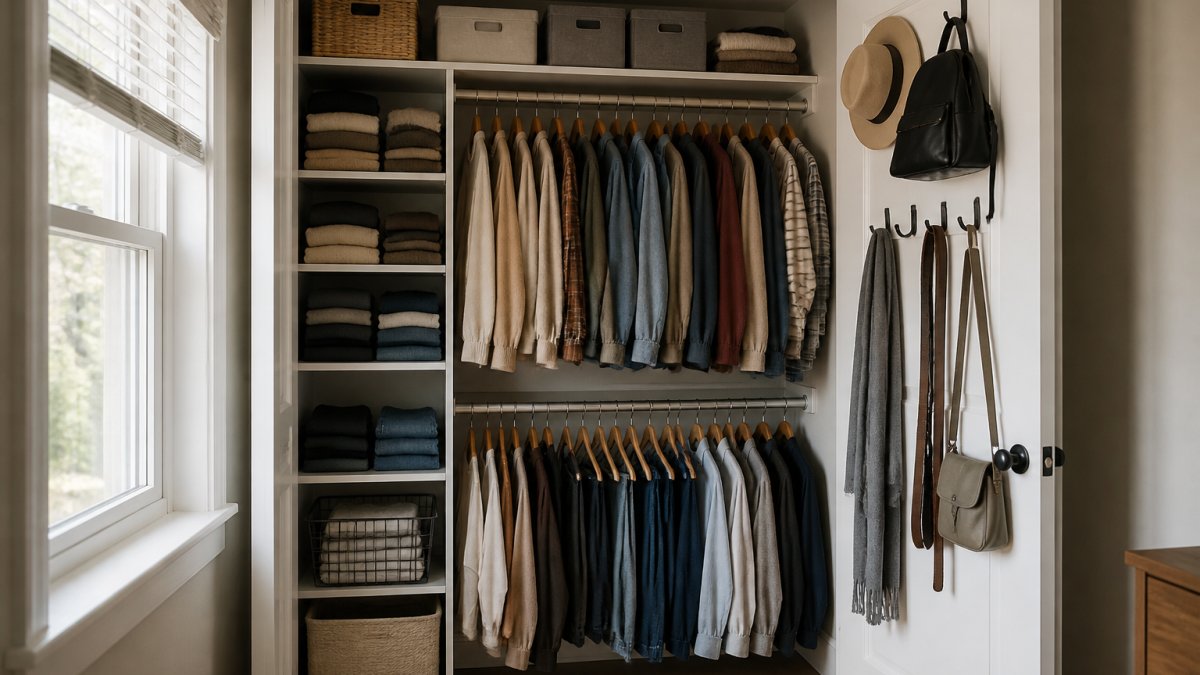
Use the shelves too. Folded clothes (sweaters, knit pants, accessories) take up less space than hanging clothes.
Hooks are your allies. Install them on the inside of the door for lightweight accessories: scarves, belts, handbags.
Also consider vertical storage bins. They slide under hanging clothes and store shoes, seasonal items, or things you use less often.
Narrow shoe cabinet for 16 pairs of shoes with 4 drawers →
Choose closet storage accessories suited to your needs
The right accessories make all the difference. Choosing closet storage accessories suited to your needs transforms chaos into order. But for a small closet, the choice depends on three practical constraints: the actual dimensions of the space, your budget, and whether you're a renter or homeowner (in other words, whether you can drill holes or not).
Start with dimensions, not wishful thinking
Before buying anything, measure and write down:
- Width of the rod and shelves (in inches).
- Depth of the shelves: most closet shelves are 12 to 16 inches deep; a deeper bin won't fit.
- Clearance height below the rod and between shelves.
- Total closet height, to determine whether you can add a shelf above the rod.
An accessory that doesn't fit these measurements will eventually be removed. Measure first, shop later.
Three solution tiers for different budgets
Prices vary by store and promotions; here are ballpark figures for comparing options in Canadian dollars.
| Tier | Type of solution | Examples | Indicative price range |
|---|---|---|---|
| Budget-friendly | No-drill, reusable | Adhesive hooks, fabric boxes, drawer dividers, tension rod | Under $30 |
| Intermediate | Modular, semi-permanent | Freestanding shelves, stackable bins, hanging shoe organizer, screw-in rod bracket | $30 to $100 |
| Durable | Installed, adjustable | Closet with adjustable shelves, double rod system, pull-out drawers | Over $100 |
Caution
Adhesive hooks have a limited weight capacity. Follow the weight limit indicated on the packaging and avoid hanging heavy bags or wet winter coats from them.
Solutions for Renters and Small Budgets
If you cannot drill holes, several options are available:
- Tension rod: attaches between two walls without screws, useful for short garments.
- Freestanding shelves: install on existing supports or a rod, without modification.
- Fabric or flexible plastic bins: lightweight, stackable, and easy to move during a move.
- Multi-level hanging organizer: hangs from the rod and adds compartments for shoes or accessories.
- Adhesive hooks and hanging strips: for scarves, belts, and light bags.
These solutions are reversible: you can remove them without leaving holes, making them suitable for rental homes.
Choose According to the Type of Item
- Shoes: a tufted shoe bench with storage keeps shoes protected from dust and provides a seat. For a narrower space, a hanging organizer with pockets frees up floor space.
- Folded clothes: shallow boxes (around 12 inches) stack well and allow you to see the contents. Fabric baskets are suitable for open closets.
- Small items: drawer dividers divide the space without drilling.
- Hanging clothes: a closet with adjustable shelves adapts to your changing needs; adjustable shelves accommodate stacks of different heights.
Key Point
The right question is not “Which accessory is the prettiest?” but “Which accessory fits my measurements, my budget, and my type of home?”. Answer these three criteria before buying.
Organize Shoes, Bags, and Accessories to Optimize Space
Shoes, bags, and accessories often take up more space than they should. Organizing these items is crucial to effectively optimize a small wardrobe.
For shoes, group them by type: work, casual, athletic, and dress shoes. A shoe storage bench with a seat and drawers combines storage and functionality: you can sit down to put on your shoes.
Handbags are best stored hanging up. Use hooks or dedicated shelves. Small bags can fit inside larger ones to save space.
For accessories (scarves, gloves, belts), use:
- Compartmentalized boxes for small items
- Hooks for scarves
- A rotating belt organizer if space allows
- Clear pouches for gloves and socks
Keep seasonal accessories separate. Store winter scarves and summer hats in closed boxes when they are out of season.
Maintain Your Small Wardrobe Organized in the Long Term
Organization is not a one-time task. Keeping your small wardrobe organized requires simple habits.
Establish a monthly routine. Spend 15 minutes checking that everything is in its place.
Before buying a new garment, ask yourself: where will it go? Do I have room? Does it match my three neutral colors?
When you put away a garment, put it back in its place immediately. Do not create a “to be put away later” pile.
Twice a year, review your wardrobe. Have you worn all the clothes? Are there pieces that no longer fit your life?
Photograph your organized closet. Keep this image as a reference. When you look at it, you will remember how everything should be stored.
Organizing a small wardrobe takes time at first, but it makes life simpler.
Frequently Asked Questions
What is the 3-3-3 clothing method and how do you apply it?
The 3-3-3 method consists of keeping three categories of clothing: those you wear regularly, those for special occasions, and those in seasonal transition. To apply it, first sort your clothes by how often you actually wore them over the past three months. Keep versatile pieces that you often combine, reserve a limited space for formal or occasional outfits, and store seasonal clothes in accessible boxes. This approach simplifies your daily choices and reduces clutter.
How to optimize a small wardrobe without buying a lot of furniture?
Optimizing a small wardrobe starts with decluttering: remove clothes you no longer wear. Then, use vertical storage by doubling your rods with a double rod or hanging multi-level organizers. Fold bulky items using the vertical method so you can see them all at a glance. Use the space above doors with hooks and use flat storage boxes under the bed. These simple solutions maximize your space without major investments.
Which closet storage accessories are really useful?
The most useful accessories are stackable storage boxes for organizing folded clothes, baskets for items within easy reach, and adhesive hooks for doors. A narrow shoe cabinet, like the one offered by Ameublement à rabais, allows you to store up to 16 pairs in a minimal space. Hanging organizers with multiple compartments maximize vertical space. Choose accessories suited to your actual dimensions to avoid wasting space.
How to sort your clothes before reorganizing your wardrobe?
Start by removing all clothes and grouping them by category: tops, bottoms, dresses, jackets. For each category, ask yourself three questions: have I worn it in the past twelve months, does it make me feel comfortable, and does it match my current style? Create three piles: keep, donate, and discard. Be honest about what you will actually wear. Once sorted, reorganize your kept clothes by type, then by color to quickly create cohesive outfits.

